Showing posts with label Eggs. Show all posts

Thursday, August 11, 2016

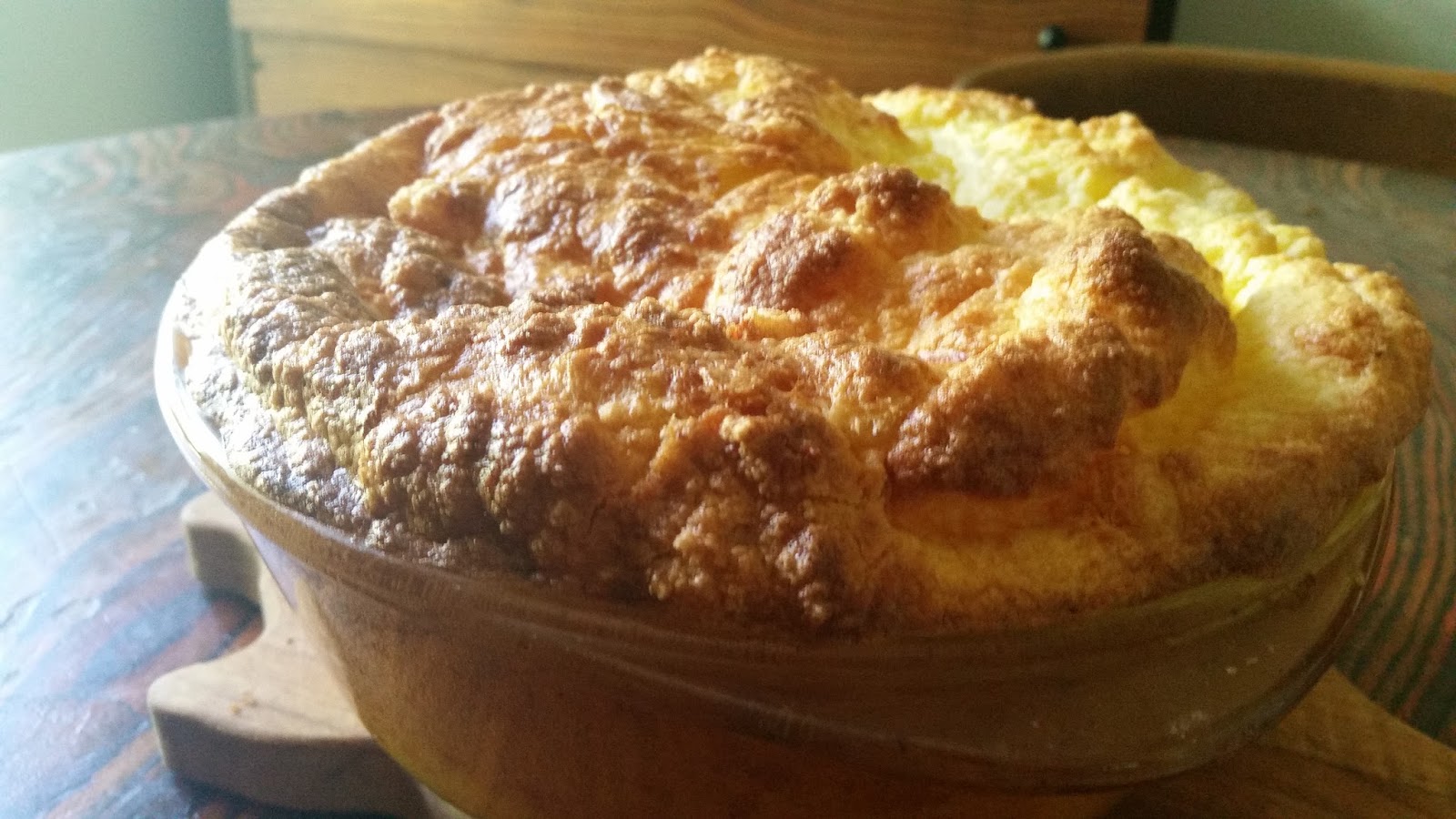
SOUFFLE AU FROMAGE: Cheese Souffle


Given that most things in the garden have so far come to pass (until next season, which is already beginning - time to start things for fall and winter), I decided to try another egg dish.  We might not have any more tender green beans, fresh tomatoes, or cucumbers, but eggs, milk, and butter are abundant.

The recent rains have made the grasses grow and grow - this year there seems to be more grass than ever before (a good thing, since we have more cows than ever before).  Was it the lime we put on last fall taking effect?  The mowing we did last year to knock back the brambles?  The extreme rotational grazing (cows are moved once a day - other people move WAY more than that, but for around here, where constant grazing is the norm, it is extreme).  The pounds-per-acre of livestock pressure we have now?  Waiting to graze during the spring until the grass was well established?  Something seems to be right.

Eggs this time of year tend to be uninspiring.  We just have so many, and it's been like that for several months.  We get sick of things after awhile.  It's part of the cycle.  If you have too much of anything, it loses it's appeal (well, that might not apply to passion fruits or Kajari melons.  I have yet to find out).  We will be so happy to have them back again in the spring.

The souffle was good - crispy on top, tender on the inside.  It was different, and cheesy.  I made it for weekend breakfast and everyone liked it.


SOUFFLE AU FROMAGE (Direct translation)
Melt a pat of fresh butter the size of an egg over a low fire; add a spoonful of flour, mix well, add half a cup of boiling milk, and stir until you get a smooth sauce.

Continue stirring until the sauce sticks to the spoon.

Remove from the fire, and add four egg yolks, incorporating them one after another, and then add the four egg whites beaten into stiff peaks.

Add 150 grams of grated Gruyère cheese, and mix into the batter.

Pour into a well-buttered oven-proof cooking dish, which is deep enough so that the batter reaches only two-thirds of its height.

Cook in an oven that is not too hot; remove when your souffle has begun to rise, after about 15 minutes.


Cheese Souffle (a modern version)

 3-4 Tablespoons of fresh butter

1 Tablespoon of flour

1/2 cup milk


4 eggs, separated

 150 grams of grated Gruyère cheese (It turned out to be about 1 cup finely grated and lightly packed)

A pinch of salt (not mentioned in the original recipe, but it would have been better with a pinch of salt,  in my opinion)

1.  To begin, butter an oven-proof casserole dish with fairly high sides (so the souffle won't spill out all over the oven), and pre-heat the oven to 350 F. 

2.  Separate the eggs.  Keep the egg yolks whole, but beat the whites up into stiff peaks and set aside. 

 3.  In a pot, begin warming the milk over a low fire.  In a sauce pan, melt the butter over a low fire and add the spoonful of flour.  Mix them into a smooth sauce called a roux.

4.  When they are well mixed (no lumps!), slowly pour in the hot milk, stirring constantly to avoid lumps.  Continue cooking and stirring constantly until the flour cooks and the roux will thicken and stick to the spoon.

5.  Remove the sauce pan from the fire, and stir in the egg yolks, one at a time.

6.  Now carefully fold in the egg whites, and then the grated cheese.  Now pour the batter into the buttered baking dish, and pop into the pre-heated oven for about 15 minutes or so (my souffle actually took more like 20 minutes to fully cook).  The souffle will rise and puff up at the top.  The recipe didn't mention it, but I have heard that opening the oven will make the souffle fall, so I kept the oven closed and checked on it through the window.

Serve right away!


Thursday, July 7, 2016

GATEAU AU FROMAGE: Cheese Pie


{These French recipes are from a French cookbook called La Cuisine:  Guide Practique de la Ménagère by Chef R. Blondeau.  This book was passed down to me from my great-grandmother, who was from Alsace, a North-eastern region on the Rhine river plain in France.  It was published in 1930 as a guide for cooks hired to cook for a family.

 I am translating the recipes from French, testing them out with home-grown or raised food, and re-writing them in a modern format, with notes about what worked for me in the kitchen} 


*     *    *    *    *    *    *    *    *    *    *    *    *    *    *    *    *    *    *    *    *

There are so many eggs this time of the year, that any egg recipe is most welcome.  I have my own version of cheese pie, or quiche - which usually includes whatever vegetables is particularly abundant at the time, and lots of home made goat cheese.  Sometimes it has a crust and some times not - I prefer the crustless quiche because I like things to be all homegrown, and also wheat does not quite agree with me - however, my children are the opposite.

The crust recipe for this quiche is interesting because it includes egg.  And it turned out very nice, I wasn't sure what to expect.  I usually use flour, butter and cold water or cream, but I think I liked the La Cuisine crust given here better.  It is rich and flaky.

The only thing was that it seemed to make more crust than I could fit in my tart pan....it looks like a large tart pan, but perhaps it is actually small.  I used all the pastry, just to be fair to the recipe, and the crust turned out rather thick.  When I make this again, I will probably make a thinner crust and use the extra pastry for crackers, or blueberry tart or something.

Naturally, this recipe comes in three parts - first the crust, and next the filling (which is for a regular quiche), and last the modification to add gruyere:


QUICHE

 Line a buttered baking dish, three centimetres deep, with a dough made as follows:

500 grams of flour;
250 grams of butter;
8 grams of salt;
2 eggs.

Bake your crust in a hot oven for 10 minutes, remove, allow to cool, and fill with a half litre of cream, 100 grams of diced butter, four whole eggs, beaten; add salt and pepper and mix it well.

Let cook in a gentle oven for 10 minutes and serve the quiche well browned and toasted.

GATEAU AU FROMAGE

Prepare as above, but replace the cream with 250 grams of grated gruyere.

baked, but not filled


filled and ready to bake again.

Cheese Pie - a modern version
For the pastry:
4 cups of flour
2 cups, plus 2 tablespoons butter (2 sticks plus 2 tablespoons)

1 teaspoon salt

2 eggs

1.  Preheat the oven to 400F while you mix all ingredients into a dough.  Roll out on a floured surface and line a buttered tart pan (about 3 centimetres deep).  Or, if you are lazy like me, press in the dough in as evenly as possible, and crimp the edges.

2. Pre-bake the crust for 10 minutes.  When you pull it out, turn the oven down to 350F.  Let the crust cool for a bit while you are preparing the filling....


for the filling:
7 tablespoons of butter, diced

4 eggs, beaten

salt and pepper

3 cups of grated gruyere

1.  Mix all the filling ingredients well.  Pour into the pre-baked crust and put back in the cooler oven for about 10 minutes.  It should be well browned and toasted when it is done.


Notes:  OK - a confession for this recipe - I did not have enough gruyere for three cups (it's so expensive if you go for the real imported stuff!!!!) - only about a cup and a half, so I added half the amount of cream to make up for it.  It took about twice as long to bake and be browned and pretty, so perhaps it had to do with the substitution.  Still, it turned out rich, creamy and flavorful.  There are no oven temperatures given in the recipe (I think they were probably assuming you are cooking on a wood stove) so I gave a good guess.

Monday, April 9, 2012

Bunnies, Eggs and More


We discovered last week that Lily had a new litter of babies that are cute and furry in time for Easter!  I didn't notice them in the nest at first and thought she wasn't bred after all, and they were pretty big before I could see them.  Lily is such a neurotic animal I didn't want to upset her more than necessary, so I didn't poke around or anything.


The pictures don't really do them justice for how incredibly cute they are.  There are six of them this time (six!!!).  Their eyes have just opened and they have been moving around the nest box.  There is one bold one in the first picture who was peeking at me.

As we primarily celebrate the pagan side of Easter, there was much egg-dyeing on Saturday.  We've been saving our little white pullet eggs for weeks.  We did the natural dyes again this year.  We used blueberries and red cabbage for the blue this year, and a good thing it was, because the red cabbage was a failure for some reason.  I can't remember how I got it to work so well last year, and I didn't have time to look it up again.  We used beets and turmeric again for red and yellow.


They were particularly pretty when we added some crayon designs before putting them in the dye.  I couldn't find our lovely beeswax crayons, so we used the regular ones.


We had so much fun trying different color combinations.  The natural dyes don't mix the same way that the regular food colors do.


The turmeric was such an intense color.  It stained my pot that I used to cook it in.  The next morning, after giving the pot several good scrubbings, I warmed up some milk for breakfast that turned out to be yellow!  The blueberries were also very potent.


They turned out so lovely again this year!
I love the soft springy colors you get with the natural dyes.


On Easter morning I woke up early and set out plates for everyone of home made treats.  The photo isn't very good (I'm still trying to figure out my new camera and my house is very poorly lit).  My friend and I had gotten together on Wednesday to make marshmallows  that I cut into bunny shapes with a cookie cutter.  We made the Nourishing Traditions macaroons, and later I baked the Czechoslovakian Easter bread my grandmother always made for us for holidays.  I made the walnut and the poppy seed version.
There was also a cloth basket of strawberries and a hand-sewn felt chick.  To be extra silly, I scattered raisins on the table, and told the kids they were rabbit droppings from the Easter Bunny.  They laughed and started eating them.


We did the traditional egg hunt later that morning.
We found all but one!
It is lurking in the yard somewhere still.


Thursday, January 12, 2012


We've been getting the most beautiful eggs lately.  The Araucauna layers have started laying their beautiful green eggs, and we've even gotten a few turkey eggs (the beautiful speckled one at the top).

The new California White layers are still too young to lay, but I am hoping they will be laying well for Easter, because everyone like the white eggs for dyeing.

The only other exciting things around here have been that we put a weaning ring on Butch, our steer from Matilda and put him out a few weeks ago.  He was supposed to be in his own paddock, but he quickly escaped and is in with Matilda and the rest of the herd now.  It was fine for a while, but he figured a way around the weaning ring, so we haven't had any milk.  There's just no way we can catch him right now, either, short of one of those nifty stun-rifle things they use for tagging wildlife.

The problem should be short-lived, because this weekend we are hoping to bring Dennis Stolzfoos's Devon bull from Full Circle Farm here, and we will be keeping him in our only permanent-fence paddock with Matilda, Geranium, Chestnut and Isla and a bale of hay, so Butch's milk-drinking spree is soon to be at an end.
What do most people do for weaning calves?  I'm hoping it will be easier once we have more calves and they can keep each other company, but I could be really, really wrong about that.

Wednesday, June 29, 2011

Catching up: Easter


For Easter this year we made our own dyes. Yellow was turmeric, red was beets, blue was red cabbage and purple was mulberry juice. We also tried coffee, but that only turned them brown, making our efforts to save four dozen white eggs a little pointless, so we didn't use it very much. For green we tried nettle infusion, but it was a little muddy. I made some nice greens with the red cabbage and turmeric, too. I've never liked soaking the eggs in food coloring, but the artistic side of me loves the bright colors, so we've always done it that way. I didn't think natural dyes would be as pretty or colorful, but I was astounded at how lovely the eggs turned out. They were not as vivid as the commercial dyes, but they were more suited to Easter, being very soft and subtle and pastel.


The blue was an amazing robin's egg blue or a perfect spring sky blue, and the mulberries were a beautiful violet. You can tell the two eggs Mirin dyed at a friend's house with regular food coloring. The colors are very bright, but have a sort of chemical look to them next to the other eggs. I have to say, these lovely naturally-dyed eggs were hard to find. They easily blended into nature. The Easter bunny (ahem) had a great time finding flowers and fallen leaves that matched the egg colors perfectly.


After we were done dyeing all the eggs I soaked strips of white muslin in the dye for a maypole. They turned out so beautiful. I couldn't believe how intensely bright they turned out.
They've faded a bit in the months I've kept them. I crocheted a little mini rug out of them, since we will probably want to dye new ones next year. Maybe someday I will have a big rug of them if I keep adding to it.